
In 1987, KFC opened its first fast-food restaurant in Beijing, China. Today, KFC can be seen in more than 1,000 cities and towns (Business Insider, 2019), and KFC has become one of the oldest western-style fast-food restaurants in China.
Developing New Retail Models
Four years ago, before the new retail concept was proposed on a large scale, “digital transformation” had been put on the agenda of Yum! China. However, for a restaurant giant like KFC, it is not easy to think about inviting customers from more than 5,000 offline stores to online at the same time. Therefore, on the road to success, it has repeatedly failed: KFC has developed three apps, including home delivery and mobile phone orders, but users only use these apps as a ready-to-go tool, not a platform.
After many attempts, KFC has found the best entry point for digital transformation: payment. This will not only make consumers’ payment behavior more convenient but also avoid corporate cash management costs. It took only six weeks for KFC and Alipay to complete the process from planning to completion, with more than 5,000 stores simultaneously accessing mobile payments (Sophie Loras, 2015).
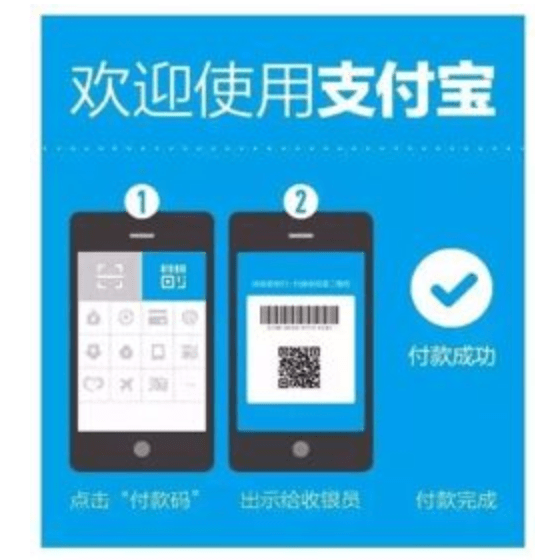


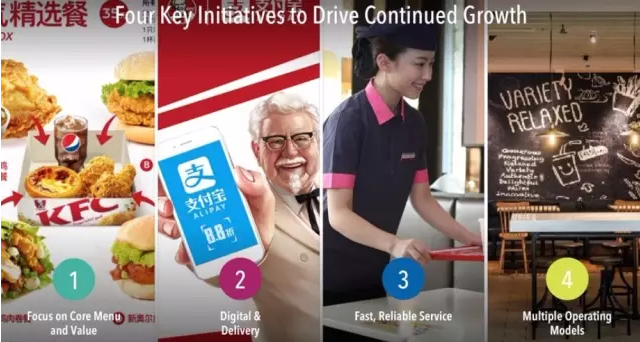
Nowadays, KFC has accumulated more than 100 million online members, and has completely built the app into a mobile platform that can be ordered, paid, reserved, and delivered. This ‘new retail’ model breaks the location restrictions, crosses time and space, and expands the service radius. In the past, catering retail relied on the promotion of traditional television, poster advertising, and certain conditions: for example, KFC’s breakfast sales are affected by the weather or the number and time of commuters’ shuttle buses. But now consumers can book an order directly through the app or choose takeaway delivery. By narrowing the restrictions on time and place and expanding the scope of services, customer satisfaction and retention rates will increase.
In the evolution of data and unmanned retail, although AI is still in its very early stages of development, it is a good medium. KFC first cooperated with Baidu on a voice ordering robot product. The video below introduces it in detail. The idea is very good, but in practice, many challenges are still encountered: for example, the extremely noisy restaurant environment makes the sound unrecognizable and the dialects are not standard enough. However, KFC is still trying, and has already established a number of artificial intelligence projects, dedicated to making technology better serve customers.
Cross-border Marketing and Sharing Economy
In addition to creating new platforms and developing intelligence, KFC’s success in digital transformation is also due to its cross-border marketing. For example, in 2017, KFC launched a KFC commemorative mobile phone in cooperation with Huawei to commemorate 30 years of opening in China. And Huawei users have K-Music song order privileges, that is, they can use the Huawei mobile phone to order the background music of the restaurant in more than 4,000 stores. When this ‘karaoke’ platform was first launched, it had 600,000 songs per month, and now it continues to attract fans to make a list of their idols by using songs. In addition, the commemorative mobile phone also includes KFC vouchers, virtual currency and other benefits (Whitwam, 2017). From the comprehensive introduction of mobile payments to the establishment of online virtual restaurants, KFC’s digitalization is moving faster and faster, and it continues to create new consumer experiences in the digital mobile era with consumers.
Another good example of cross-border marketing is the cooperation with mobile game ‘Onmyoji’ in 2017. If the player is in a KFC physical store, he can encounter special bosses and get unique rewards. Purchase game packages at KFC also get rich redemption codes for game items (KFC X ONMYOJI, 2017). This linkage activity allows virtual content to be combined with real-life, online and offline experiences, which greatly increases the consumer’s sense of interaction, and also enhances the operating profit of the companies on both sides. It is successful win-win cooperation.


In addition to cross-border marketing, KFC is also involved in the sharing economy. In China, many stores have begun to provide shared charging treasures and shared umbrellas in stores, and you can rent them by scanning the QR code. In addition, KFC also launches e-vouchers from time to time to share links, and offers special membership food and other welfare activities every Thursday.
In general, KFC has been promoting music cooperation, sports cooperation, game cooperation, variety cooperation, new technology applications and digital experiences in recent years, and strived to transform from traditional enterprises to intelligent marketing, and has achieved success:every year sales and number of stores are increasing. Taking 2019 as an example, in 2019, KFC’s total sales increased by 11% year-on-year, same-store sales increased by 4%, and the number of stores increased by 742 compared with last year. According to the plan, Yum! China will continue to increase investment in IT infrastructure and supply chain in 2020, so it still has good development prospects.
Reference:
Business Insider. (2019). KFC is by far the most popular fast food chain in China and it’s nothing like the US brand — here’s what it’s like. [online] Available at: https://www.businessinsider.com/most-popular-fast-food-chain-in-china-kfc-photos-2018-4?r=US&IR=T [Accessed 2 Mar. 2020].
KFC X ONMYOJI. (2017). Spikes Asia Festival of Creativity. [online] Available at: https://www2.spikes.asia/winners/2017/integrated/entry.cfm?entryid=2569&award=101&order=2&direction=1 [Accessed 2 Mar. 2020].
Sophie Loras. (2015). KFC Offers Alipay Mobile Payments to Chinese Customers – ClickZ. [online] ClickZ. Available at: https://www.clickz.com/kfc-offers-alipay-mobile-payments-to-chinese-customers/25289/ [Accessed 2 Mar. 2020]
Whitwam, R. (2017). Huawei Announces Hilarious Special Edition KFC Phone In China. [online] Forbes. Available at: https://www.forbes.com/sites/ryanwhitwam/2017/07/12/huawei-announces-hilarious-special-edition-kfc-phone-in-china/#ef5b0b642680 [Accessed 2 Mar. 2020].
 Life Goes On
Through reading this blog, I can have a better understanding about how KFS succeed to achieve digital transformation in China. As I expected, at beginning FKC failed to persuade users to use the apps it developed as a platform. Instead, these apps are used as a ready-to-go tool. The author first introduced some challenges KFC met in China Market, which led readers to think of the really effective way developing new retail models in China for KFC. The author introduced directly that the best entry point for digital transformation is payment for KFC. It would be better if more details about KFC’s attempts are included here. Another important factor for KFC’s success is its cross-border marketing and sharing economy. Examples of influential marketing campaign are mentioned, which is useful! More details about the supportive policy environment in China can be discussed, for it can help readers have a more comprehensive about the social background of KFC’s success.
LikeLike
Hi Xiyao,
Your blog is well organized and easy to read. I entirely agree with what you said that KFC had realized mobile payment, and its cooperation with Alipay is a sage move. In my personal experience, I love to use the electronic client platform to pay because it can bring amazing discounts when I place an order. Moreover, mobile platforms bring more fabulous imagination for marketing and remarketing. Attracting customers into the store through payment promotions, or issuing secondary coupons to stimulate customers to enter the store again, becoming an active channel for the brand to reach users, and more importantly, it can also retain more valuable user preference data.
Finally, I would like to say that in today’s big data environment, the success of an enterprise is not only about providing a good product but in a materialistic world, to provide customers with better services and carry out marketing with memories. Therefore, the stores we see on the street are becoming more and more similar; most of them are big chain companies because they are changing the profit model with the digital trend. Do you agree with me?
LikeLike